News ·
Five fascinating facts about crown-of-thorns starfish
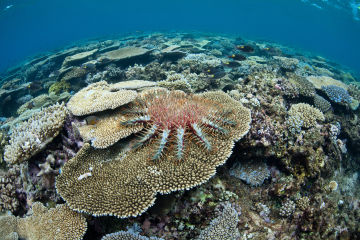
Crown-of-thorns starfish (COTS) are a native species on the Great Barrier Reef, but pose a major threat to coral populations. They eat up to 10 square metres of coral a year and, with long needle-sharp spines covering their body, they’ve got built-in protection from predators.
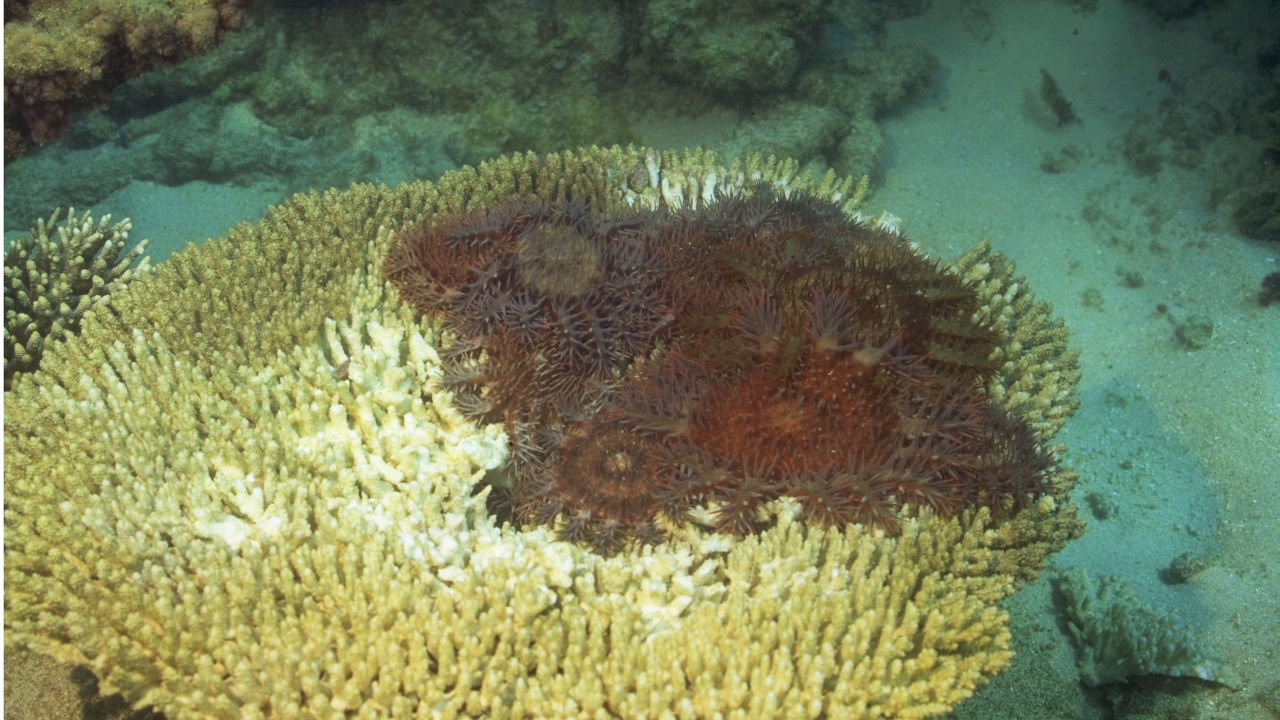
The Great Barrier Reef has experienced four major COTS outbreaks since the 1960s, with a fifth wave now emerging.
With our partners, we’re working to advance the technology that helps us decide when and where to intervene to best protect coral reefs.
Here are five fascinating facts about crown-of-thorns starfish.
1. COTS are thorny in name and nature
Crown-of-thorns starfish received their common name from the needle-sharp spines that cover their arms and body that supposedly resemble the biblical crown of thorns. Their scientific family name – Acanthaster - means almost the same thing. In Latin, Acanth means thorny and aster means star.
2. COTS have lots of predators
Despite their toxic spines, lots of animals on the Reef eat COTS. Until very recently, scientists believed only the giant Pacific triton snail could digest them, but we now know many fish and crustaceans dine on these starfish, particularly while they are young and don’t have as many toxic spines.
3. COTS have eyes in their arms
In the dark of night, you might spot COTS crawling across the reef at a whopping 30cm a minute. That’s relatively fast for a starfish. Like all starfish, COTS have tiny water-powered tube feet underneath their bodies that inflate, extend and walk them forward. A special light-sensitive eye spot located in the end of each arm helps the starfish to orientate themselves and find their feeding grounds.

4. COTS are supersized starfish
Starfish are famous for their “arms” that give them their star-like shape. Of the 2,000 species that inhabit our oceans, the classic five-armed starfish are the most common. But some, like the crown-of-thorns, take it to a whole new level. They’re one of the largest of all starfish, growing more than 20 spine-covered arms in their lifetime and reaching 50cm in diameter.

Credit: Reef Authority
5. COTS feed by ejecting their stomachs onto their food
COTS prefer their food alive – and luckily for them coral doesn’t go anywhere fast. The starfish have an exclusive diet of stony coral, preying on the polyps that make up the coral’s soft tissues. They project their stomach from their mouths, covering an area almost as big as they are. Their digestive juices liquify the coral beneath and the starfish absorb the meal. They then invert their stomach back inside their body.
What are we doing to protect coral reefs from COTS outbreaks?
COTS are controlled by injecting individual starfish with either bile salts (derived from oxen) or household vinegar. This targeted method is lethal to the starfish but harmless to the surrounding reef ecosystem.
This work is delivered through the COTS Control Program, led by the Great Barrier Reef Marine Park Authority. The program has achieved up to a six-fold reduction in COTS numbers and a 44% increase in coral cover across regions that received timely and sustained control effort.
Despite this progress, challenges remain. With outbreaks continuing to spread across the Reef, there is an urgent need to invest in research that improves our ability to manage COTS outbreaks at scale and adapt to future conditions. The COTS Control Innovation Program (CCIP) is a targeted research program aimed at boosting our capacity to predict, detect and respond to COTS outbreaks at scale across the Great Barrier Reef.
CCIP is a collaborative research partnership between the Foundation and leading institutions with COTS expertise – AIMS, CSIRO, James Cook University and the University of Queensland. Our research directly improves the on-ground approach to coral protection by the COTS Control Program. Every coral we save from COTS can reproduce and help repopulate damaged areas.